Plug-in solar panels: are they worth it in the UK?
For years the answer to “can I just plug a solar panel into the wall?” was no. Since 27 August 2026 it has been yes — with conditions. Kits are now in Currys, B&Q, Screwfix, Argos and Amazon, and almost every “are they worth it?” article is written by someone who sells one.
This one isn’t. Here’s the real saving, a payback calculator built on the government’s own yield figures, the rules in plain English, and a checklist if you rent or lease.
Information, not advice. We don’t recommend products or providers. Check the official sources linked at the bottom before you act.
What a plug-in solar kit actually is
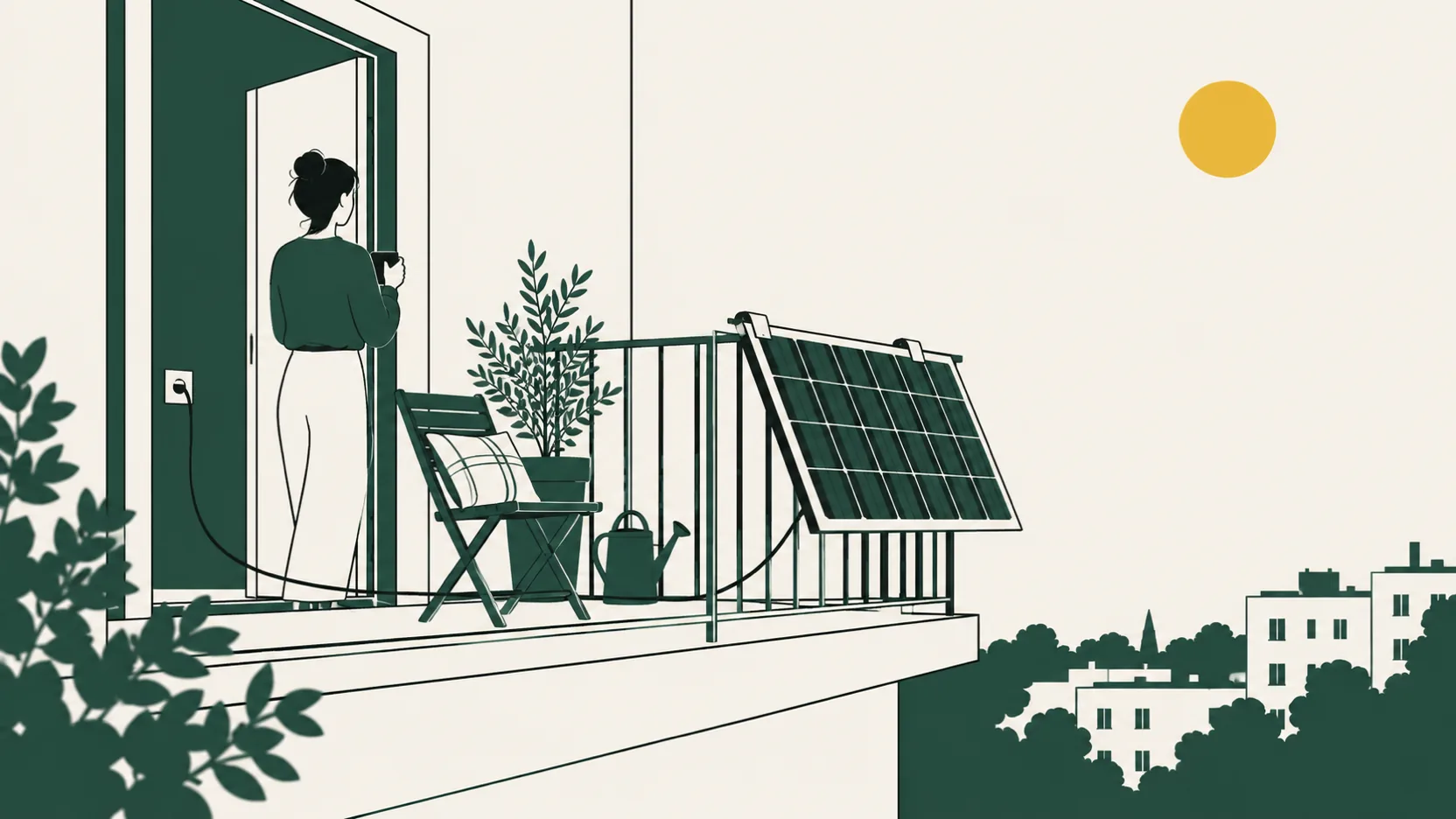
A plug-in (or “balcony”) solar kit is one to four panels, a small inverter that turns their output into mains electricity, a mount, and a cable ending in a normal three-pin plug. Put it somewhere sunny, plug it in, and while the sun shines it feeds your home’s wiring. Your appliances use that first and draw less from the grid.
The important word is while. There is no storage, and no payment for anything you don’t use. That shapes everything about whether it’s worth it.
Government modelling assumes a typical kit costs £500 (DESNZ impact assessment, 16 July 2026); real prices depend on how many panels and what mount you get, so use the calculator with the price of the kit in front of you.
How much does it save? The two things sellers skip
The government’s launch headline is “up to £110 a year”, with an 800 W kit covering “up to 20% of an average home’s electricity use”. That £110 is real — but look at what sits behind it in the impact assessment (Table 7):
| Setup | Generated a year | Share used at home | Saving a year |
|---|---|---|---|
| 800 W, tilted ~30°, facing south | 690 kWh | 62% | ~£110 |
| 800 W, upright (90°), facing east or west | 378 kWh | 72% | ~£70 |
Both rows assume a household that is home all day. That’s the first thing sellers skip.
1. Self-consumption. Panels generate most between about 10am and 4pm. If nobody’s home and the fridge is the only thing running, most of it flows straight back out to the grid. On a rooftop system you’d be paid for that under the Smart Export Guarantee. On a plug-in system you are not — the government’s assessment says SEG “is likely not to apply”, because there’s no MCS certificate or export metering. Exported electricity is a gift to your supplier.
2. The 800 W cap. By law the inverter can’t push more than 800 W into your home. You can connect up to 2,000 W of panels behind it (the spec recommends an electrician’s assessment above 960 W), and bigger panels help on dull mornings and evenings — but a “1,600 W kit” will never give you double the output of an 800 W one.
The honest one-liner: plug-in solar is worth it if someone is home in the day, the kit faces south or close to it, and you’re paying today’s unit rate or more. Change any one of those and the maths gets thin; change two and it may never pay back.
Try your own numbers. The calculator uses the yield figures above, the SAP shading factors and the current price-cap electricity rate (26.32p per kWh from 1 October 2026), and only counts the kWh you’d actually use.
Worked examples at today’s unit rate
All at 26.32p per kWh and a £650 two-panel (800 W) kit.
- Home most days, south-facing, no shade. 688 kWh generated, 516 kWh used. £136 a year, payback 4.8 years, about £2,070 ahead after 20 years.
- Home some of the day, south-facing, no shade. 378 kWh used. £100 a year, payback 6.5 years.
- Out all day, south-facing, no shade. Only 241 kWh used — the rest leaves the house for nothing. £63 a year, payback 10.3 years.
- Out all day, east/west balcony rail, some shade. 302 kWh generated, 106 kWh used. £28 a year, payback 23 years — longer than the panels will reasonably last. Don’t.
- Single 400 W panel (£450), east/west, home some of the day. £27 a year, payback 16 years. Cheap single-panel kits look tempting, but the fixed costs (inverter, mount, cable) eat the return.
Two things make every case better: a higher unit rate (the January 2027 cap is forecast higher), and shifting daytime loads — run the washing machine, dishwasher and slow cooker between 10am and 3pm and your self-consumption climbs.
Two things make it worse: panels degrade slowly, and the inverter is the part most likely to fail — the government’s model assumes a £100 replacement after 10 years. Our 20-year figure ignores both; treat it as a ceiling, not a promise.
What the law actually says (SI 2026/848)
The change is The Plugs and Sockets etc. (Safety) Regulations 1994 and Electricity Safety, Quality and Continuity Regulations 2002 (Amendment) Regulations 2026 — made 16 July 2026, in force 27 August 2026, Great Britain only (the Energy Saving Trust notes Northern Ireland does not currently permit plug-in solar).
To be legal to sell and use under the plug-in route, a device must:
- generate from sunlight only, with a maximum rated AC output of 800 W (800 VA and 3.5 A in the specification);
- connect through a standard plug and socket — a non-rewireable moulded BS 1363 plug with a fuse of no more than 5 A;
- not be designed to import energy to store it — in plain English, no battery;
- meet the Plug-in Solar Device Interim Product Specification v2 (16 July 2026) — and say so on the product.
The specification adds the practical rules: no more than 2,000 W of panels behind the inverter, one device per household (the G98 network rule), socket circuits only (never lighting or a cooker spur), no extension leads, adaptors or RCD plugs — the plug goes straight into the wall — and modern RCD/RCBO protection at the consumer unit. If you still have old rewireable fuses, the Energy Saving Trust says don’t install.
The battery catch
Kits bundled with a battery are widely sold in Europe. In Britain they are outside the plug-in route: the government response says battery-integrated products “remain outside the scope of the current framework”, and every compliant kit must warn that it is “not intended to be connected to, operated with, or used in conjunction with a battery energy storage system”. Electrical Safety First is blunter: don’t install plug-in battery systems in your home.
A battery can still be added to a home — as a properly installed, notified system, not something you plug in. If a listing shows a battery, it is not a compliant plug-in kit.
Telling your network operator (G98)
Any generator on the grid has to be notified to your Distribution Network Operator — the company that owns the wires, not your supplier. For plug-in solar Ofgem approved a simplified G98 process on 11 August 2026: the customer notifies the DNO when the device is installed and again if it’s removed, and only one plug-in device per household is allowed.
Compliant products must be labelled saying DNO notification is mandatory, with a link or QR code. It goes through the Energy Networks Association’s free Connect Direct service; you’ll need your postcode and the make and model. The Energy Saving Trust calls registration “a legal requirement”; London Fire Brigade says do it within 28 days. It’s a five-minute form.
The renters’ and leaseholders’ checklist
Plug-in solar was legalised largely for people who can’t put panels on a roof. That doesn’t mean you can just do it. Before you spend anything:
- Permission in writing. Tenants need the landlord’s consent; leaseholders should read the lease for restrictions on balconies, external walls, railings or communal areas, and ask the freeholder or managing agent (in Scotland, the property factor). The product specification itself says users “must obtain landlord, freeholder or managing agent consent”. Listed buildings and conservation areas should also ask the council.
- Choose a freestanding or clip-on mount. Fixings must be reversible and non-permanent, and not drilling into the building keeps you on the right side of your tenancy. Cable ties, straps, tape and bungees are explicitly banned — the mount must be designed for wind and snow loads.
- Check what the balcony can take. Two panels plus a mount are heavy, and wind on an upright panel adds a lot more. The kit must come with a structural specification for its mount — read it, and if you’re unsure the balcony or railing is rated for it, ask the building manager. Never mount on a timber balcony.
- Ask about cladding and fire safety. No installation on buildings with ACM/MCM, HPL or timber cladding, or under external-wall remediation. Keep panels and cables clear of escape routes, windows and shared walkways; taller blocks may have extra fire-safety rules.
- Check the socket and circuit. An outdoor socket must be weatherproof (IP65 or better) and fitted by an electrician; indoors, the circuit mustn’t also run lighting or a fixed appliance. Test the RCBO every six months while the panels are generating.
- Tell your insurer. Contents insurance may cover the kit; buildings cover is the freeholder’s.
- Plan the exit. When you move, unplug it, de-register it with the DNO and take it with you — one genuine advantage over rooftop solar.
Where to buy a compliant kit
Four things to check on any listing before you add to basket:
- It states compliance with the Plug-in Solar Device Interim Product Specification (Electrical Safety First says the product must state this), and ideally that the model is on the ENA’s Connect Direct device register.
- Inverter output is 800 W AC or less — panel wattage can be higher; the inverter rating is what matters.
- No battery included or bundled.
- A moulded three-pin plug and a mount designed for the kit — not a European plug with an adaptor, and not a bag of cable ties.
Buy from an established retailer rather than a marketplace seller with no UK address — you want a real warranty on the inverter. And note VAT is the full 20% on a kit you install yourself; the 0% rate on solar only applies when the supplier installs it.
- Amazon — plug-in solar kits · widest choice — check each listing carefully
- Currys — plug-in solar kits · high-street retailer, named by government as a launch stockist
- B&Q — plug-in solar kits · DIY retailer, named by government as a launch stockist
Plug-in versus a proper rooftop system
A plug-in kit is not a small rooftop system; it’s a different product for a different person. Rooftop solar costs around ten times as much, generates about five times as much, earns export payments and can pair with a battery — but you need a roof you own and an installer. If you have those, read our guide to heat pumps, solar and batteries first.
If you don’t, a plug-in kit is a sensible £500–£700 experiment with a 5–7 year payback if the house is used in the daytime. Either way, the cheapest kWh is the one you don’t use — cutting your energy bill will probably save you more this winter than any panel.
All our calculators are at /tools.
Frequently asked questions
Are plug-in solar panels legal in the UK?
Yes, in Great Britain since 27 August 2026 under SI 2026/848, if the kit is 800 W AC or less, meets the Interim Product Specification, uses a moulded BS 1363 plug and has no battery. Northern Ireland does not currently permit them.
How much does a plug-in solar kit save a year?
Government modelling says about £110 a year for an 800 W kit tilted south with someone home in the day, and about £70 for an upright east- or west-facing balcony setup. Empty the house in daytime and those roughly halve, because exported electricity earns nothing.
How long until it pays for itself?
At 26.32p per kWh, a £650 south-facing 800 W kit pays back in roughly 5–7 years with someone home, and about 10 years if everyone is out all day. A single shaded 400 W panel may never pay back.
Can I add a battery?
Not under the plug-in route. The law defines a plug-in device as one not designed to store energy, and every compliant kit must warn against connecting a battery. Kits sold with batteries are not legal plug-in kits in Britain.
Do I have to tell my electricity company?
You must notify your Distribution Network Operator (the wires company, not your supplier) via the ENA’s Connect Direct (there should be no charge) service. Only one plug-in device is allowed per household.
Can I use one if I rent?
Often yes — that’s who the scheme is for. Get written permission first, use a freestanding or clip-on mount, check the balcony can take the weight, avoid timber balconies and cladded buildings, and tell your insurer.
Last checked 29 October 2026 against legislation.gov.uk, the DESNZ specification and impact assessment, Ofgem’s G98 decision and the Energy Saving Trust checklist. The unit rate updates each quarter from our price-cap tracker.
Sources
- legislation.gov.uk — The Plugs and Sockets etc. (Safety) Regulations 1994 and ESQCR 2002 (Amendment) Regulations 2026 (SI 2026/848)
- DESNZ — Plug-in Solar Device Interim Product Specification v2 (16 July 2026)
- DESNZ — Plug-in solar final-stage impact assessment (16 July 2026)
- GOV.UK — Households can save as plug-in solar panels come to market (26 August 2026)
- GOV.UK — Plug-in solar consultation and government response
- Ofgem — Decision to approve DCRP/MP/26/02 (G98 amendment for plug-in microgeneration, 11 August 2026)
- Energy Saving Trust — Plug-in solar panels: checks to make before you buy
- Electrical Safety First — Plug-in solar panels: what to know before buying (August 2026)
- London Fire Brigade — Plug-in solar panels: safety advice for residents
- GOV.UK — VAT on energy-saving materials (Notice 708/6)
- Ofgem — Energy price cap 1 October to 31 December 2026
Just so you know: this guide is information and journalism, not financial advice, and we don't recommend specific financial products. Your circumstances are your own — if you need personal advice, speak to a suitably qualified adviser. Information was correct at the "last updated" date above but things change; always check the linked primary sources.