Parking fines: council PCN vs private charge — how to appeal
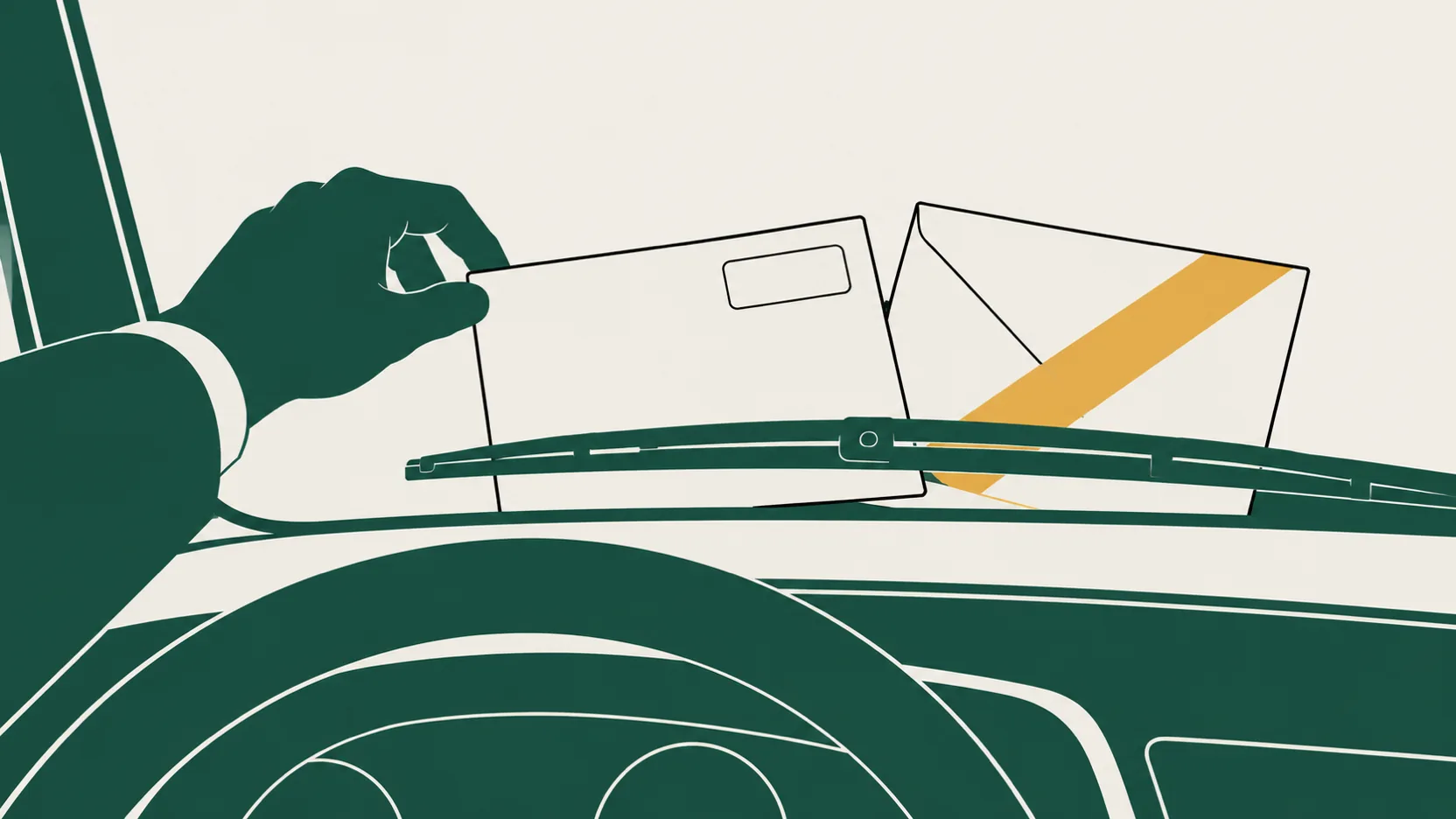
Two yellow envelopes, two very different problems — and the checker below tells you which one you’re holding. One is a fine from your council, backed by law, with a discount that evaporates after two weeks and bailiffs at the far end. The other is an invoice from a private company, dressed up to look like the first one, which can only be enforced by taking you to the small claims court. Most people treat both the same way — pay in a panic or ignore in a huff — and each of those is the wrong answer for one of them.
Information, not advice. We don’t recommend products or providers. Check the official source linked below before you act.
Council PCN or private parking charge: how to tell in ten seconds
Read the title on the ticket.
| On the ticket | Who issued it | What it is |
|---|---|---|
| Penalty Charge Notice (PCN) | Council, Transport for London, Department for Infrastructure (NI) | A statutory penalty |
| Parking Charge Notice | A private company | A contractual claim — an invoice |
| Fixed Penalty Notice (FPN) | Police, DVSA, a few councils | A criminal-law penalty |
| Excess Charge Notice (ECN) | Some councils, in their own car parks | A council charge under older rules |
Some operators print “PCN” large and “Parking Charge” small. Two more tells: a company name rather than a council crest, and words like “contractual” or “the landowner”. Where you parked settles the rest: roads and council car parks mean the council; supermarkets, retail parks, hospital contractors, residential blocks and — in England and Wales since 26 December 2025 — station car parks mean a private operator.
Is it a fine or an invoice? Why the difference matters
A council PCN is a penalty created by statute. The council only has to show a contravention happened; in return the law gives you a set appeal process ending at an independent tribunal, and limits what the council can do if you don’t pay. You cannot get out of a PCN by ignoring it.
A private parking charge is a claim that you made a contract by parking under the signs, and broke it. The operator can’t fine you — only a court can order you to pay. That’s a real difference, not a loophole: operators do go to court, and a clearly-signed overstay is a contract courts enforce. So the right approach is neither “pay instantly” nor “bin it”, but appeal properly, in the right order, and keep the paperwork.
Council PCN: the deadlines and the appeal route
How much. Outside London, councils use one of two bands set by the 2007 (England) and 2008 (Wales) Orders: £70 or £50, or £60 or £40, the higher figure for more serious contraventions such as double yellow lines. In London the levels rose on 7 April 2025 to £160 or £110 (band A) and £140 or £90 (band B).
The 14-day discount. Pay within 14 days of the date on the ticket and you pay half. For camera-recorded contraventions — bus lanes, camera cars, red routes — the window is 21 days.
The appeal route, in order:
- Informal challenge (windscreen tickets only). Write to the council straight away, with photos. Do it within the 14 days and, if rejected, the discount is almost always re-offered for another 14 days — the Traffic Penalty Tribunal says so plainly. Enforcement pauses meanwhile.
- Formal representations. If that fails, or the PCN came by post, a Notice to Owner goes to the registered keeper and you have 28 days to make representations on a statutory ground — the contravention didn’t occur, you weren’t the owner, defective signs or lines, a procedural error, or mitigating circumstances. Attach evidence.
- Independent appeal. A Notice of Rejection gives you a code and 28 days to appeal to the tribunal: the Traffic Penalty Tribunal in England (outside London) and Wales, London Tribunals in the capital, the General Regulatory Chamber in Scotland and the Northern Ireland Traffic Penalty Tribunal. All free, all independent, all binding on the council. Costs are almost never awarded against a motorist.
The one thing not to miss: on a council ticket, challenge within the 14 days. You keep the discount if you lose and you lose nothing by trying. Wait until day 20 and you’ve already paid for the privilege of arguing.
If you ignore it. 28 days after an unpaid Notice to Owner or a lost appeal, a Charge Certificate adds 50% — a £70 ticket becomes £105, a £160 London one £240. 14 days later an Order for Recovery arrives from the Traffic Enforcement Centre with a witness-statement form. Ignore that and a warrant goes to enforcement agents, whose fees under the 2014 regulations are £75 for the first letter and £235 for a visit. A £35 discounted ticket can become a £400 problem.
Private parking charge: the deadlines and the appeal route
Private parking in Great Britain currently runs under the BPA/IPC industry Single Code of Practice, and from late 2026 under the government’s own Code (next section). The headline numbers are the same under both.
How much. The cap is £100, with a minimum 40% discount for paying within 14 days of the notice. The government Code adds a £20 reduced charge for minor errors such as one wrong registration character or a valid permit you forgot to display.
Grace periods. Operators must allow 5 minutes on arrival to read the signs and decide, and 10 minutes’ grace after your time ends, in all but the shortest-stay car parks. A three-minute overstay is a charge you should appeal.
The appeal route, in order:
- Appeal to the operator, in writing, within 28 days of the notice arriving. Say you are the registered keeper and do not say who was driving — the next section explains why. Set out your grounds, attach evidence and ask for theirs: photographs, ANPR timings, a signage plan and proof of the landowner’s authority. They have 28 days to respond and must pause recovery meanwhile.
- Independent appeal. A rejection must name their trade body and give you a code. British Parking Association members go to POPLA; International Parking Community members go to the IAS. You have 28 days from the rejection. Both are free; a win binds the operator, a loss means the discount has gone and they can pursue the full £100.
- Court. There is no further appeal body. If the operator issues a claim you defend it in writing on the small-claims track, where costs are strictly limited. Defend it — don’t ignore it.
The discount while you appeal. Appeal within the 28 days and the discounted rate should stay open for 14 days after a rejection — IPC practice already, written into the government Code for everyone, honoured by BPA members “in most cases”.
The keeper-liability check (England and Wales only)
The technicality that wins more private appeals than any other. Under Schedule 4 of the Protection of Freedoms Act 2012, an operator can only pursue the registered keeper (rather than the unknown driver) if it kept to the timings. With no windscreen ticket, the Notice to Keeper must arrive within 14 days of the parking event; if a windscreen ticket was left first, the keeper notice must arrive 28 to 56 days after it. Miss the window and the operator can only pursue the driver — which is why you never name the driver. The checker counts the days if you give it the date you parked.
Schedule 4 does not apply in Scotland or Northern Ireland: there the operator can only pursue the driver, and must prove who that was.
What happens if you ignore a private parking charge
The question people are nervous to search for, answered plainly as at 29 October 2026:
- It is not a criminal matter. No points, no criminal record, nothing on your licence. It’s a contract dispute.
- You will get letters. Reminders, “final demands”, then a debt-recovery firm adding a fee of up to £70. A debt collector writes letters; it cannot enter your home, take goods or add anything a court hasn’t awarded.
- The operator can issue a county court claim (sheriff court in Scotland), and the larger ones routinely do. If a claim form arrives, respond by the date on it. Many claims fail on signage, grace periods or Schedule 4; many succeed because the driver simply overstayed.
- A County Court Judgment only happens at the very end: a claim issued, ignored or lost, and then unpaid. Even then, pay in full within a month of the judgment and it’s removed from the register. Nobody gets a CCJ from a parking charge — only from a court claim they didn’t deal with.
So “ignore it” isn’t advice we’d give: appealing properly is calmer and more likely to end it. But if you’ve already ignored one for months, the position is exactly as above — not worse.
Where the rules are as at October 2026
The Parking (Code of Practice) Act 2019 promised a government code with legal force. A first version was issued in February 2022 and withdrawn four months later after operators challenged its halving of the cap; the BPA and IPC filled the gap with their own Sector Single Code from 1 October 2024.
On 20 October 2026 the government laid its own Private Parking Code of Practice before Parliament. It keeps the £100 cap, the 40% / 14-day discount and the £70 recovery-fee cap “as an interim measure”, puts the 5- and 10-minute periods and the £20 reduced charge into law, and promises a further consultation on banning recovery fees. It sits before Parliament for 40 days and takes effect 21 days after issue — the legal press expects issue around 30 November 2026, so in force just before Christmas. No new appeals body: POPLA and the IAS continue. It covers England, Wales and Scotland; we’ll update this page when the dates are confirmed.
Scotland and Northern Ireland: the differences in one place
- Council PCNs have the same shape — 50% off within 14 days, 28 days to pay or challenge, 50% uplift if ignored — with appeals to the General Regulatory Chamber in Scotland and the NI Traffic Penalty Tribunal, each within 28 days of the Notice of Rejection.
- Private parking in both nations is pure contract law against the driver only: no Schedule 4, no keeper liability. POPLA and the IAS still handle appeals.
- Station car parks in Scotland were not removed from the railway byelaws in December 2025. A notice citing Byelaw 14 is a criminal byelaw penalty — challenge it with the issuer promptly rather than treating it as an invoice.
A worked example
Priya gets a letter dated 20 October 2026, arriving 22 October, from a parking company about a Leeds retail park she visited on 1 October. It says “PCN”, demands £100, offers £60 within 14 days. She did overstay — by nine minutes.
The checker calls it a private charge (company name, “Parking Charge” in the small print). Her discount runs to 2 November, her operator appeal is due by 18 November. The notice arrived 21 days after she parked with no windscreen ticket — outside the 14-day Schedule 4 window, so she can’t be held liable as keeper — and nine minutes is inside the ten-minute grace period anyway. Her letter makes both points, names no driver, and asks for the signage evidence. If it isn’t cancelled at stage one, POPLA.
Swap the company for the council and the retail park for a single yellow line: a £70 PCN, 50% off until 2 November, and she has no grounds. The right move is to pay £35 before the window shuts. Different ticket, opposite answer.
Related reading: your broader consumer rights, how to complain and escalate, and — since station car parks are often where it starts — train delays and cheaper fares. More free calculators are on our tools page.
Frequently asked questions
Do I have to pay a private parking charge notice?
Not automatically — it’s an invoice, not a fine. But a court will enforce clearly-signed terms you broke, so: appeal if you have grounds, pay the discounted amount if you don’t, and never ignore a claim form.
What’s the difference between a Penalty Charge Notice and a Parking Charge Notice?
A Penalty Charge Notice is a statutory penalty from a council or transport authority; a Parking Charge Notice is a private company’s claim for breach of contract. The names sound alike; the law isn’t.
How long do I have to appeal a parking ticket?
Council PCN: 28 days to pay or challenge, 50% off within 14 (21 for camera cases), then 28 days from each later notice. Private charge: 28 days to appeal to the operator, 40% off within 14, then 28 days from their rejection to POPLA or the IAS.
What happens if I ignore a private parking ticket?
Letters, possibly a £70 debt-recovery fee, possibly a county court claim. No criminal record, and a CCJ only if a claim is issued, ignored or lost, and then unpaid for a month.
Can I appeal after I’ve paid?
A council PCN: paying ends it. A private charge: the government Code adds a 30-day post-payment appeal in limited cases, but appeal first, pay second.
Is a railway station parking ticket a fine?
In England and Wales, not since 26 December 2025 — it’s a private charge. In Scotland a notice citing Byelaw 14 can still be a criminal penalty, so challenge it promptly.
Sources
- GOV.UK — Parking tickets: challenging a ticket
- GOV.UK — Private Parking Code of Practice: government response (20 October 2026)
- Ministry of Housing, Communities and Local Government — Private Parking Code of Practice (laid October 2026, PDF)
- Traffic Penalty Tribunal — Parking PCNs in England (outside London) and Wales
- London Tribunals — the appeals process explained
- legislation.gov.uk — Protection of Freedoms Act 2012, Schedule 4 (keeper liability)
- legislation.gov.uk — Civil Enforcement of Parking Contraventions (Guidelines on Levels of Charges) (England) Order 2007
- legislation.gov.uk — Civil Enforcement of Parking Contraventions (Guidelines on Levels of Charges) (Wales) Order 2008
- Wandsworth Council — London-wide PCN levels from 7 April 2025
- POPLA — Grace periods and appeal deadlines (6 August 2026)
- IAS — Before you appeal
- mygov.scot — Council penalty charge notices
- Citizens Advice Scotland — Parking tickets on private land
- Department of Justice NI — Northern Ireland Traffic Penalty Tribunal
- GOV.UK — County court judgments for debt
- GOV.UK — Railway byelaws (station car parks removed from byelaws in England & Wales, 26 December 2025)
- legislation.gov.uk — Taking Control of Goods (Fees) Regulations 2014 (bailiff fees)
Just so you know: this guide is information and journalism, not financial advice, and we don't recommend specific financial products. Your circumstances are your own — if you need personal advice, speak to a suitably qualified adviser. Information was correct at the "last updated" date above but things change; always check the linked primary sources.